
JOURNAL
Before the Crossing

Before a crossing, there is often a long stretch where very little seems to happen.
The vehicle settles into place and conversation drops naturally. Ahead, the herd gathers and breaks apart again, uncertain in the way wildebeest often are when water is near. Your guide watches without trying to fill the silence.
This is the part of migration that is harder to describe, because it is not yet movement. It is the feeling of being close to something that has not decided what it will become.
In the northern Serengeti, the Great Migration is often spoken about in numbers and distance, with herds moving across the plains in search of rain, grass and water. But when you are actually there, the scale becomes less important than the atmosphere around you.
Nothing has happened yet, and somehow that is exactly why everyone keeps watching.

The migration changes the feeling of the northern Serengeti before it changes the view.
There are more animals on the plains, of course. More movement in the distance. More attention drawn towards the river and the routes that lead there. But the shift is not only about numbers. It is in the way the landscape feels more alert, as though everything is waiting for something that cannot be timed.
Guests often arrive expecting movement. What surprises them is how much of the experience sits in the pause before it.
A herd may stand for hours, edging forward and turning back, unsettled by something no one can fully see. Zebra move through the edges, reading the same signals in their own way. The river may be close, but closeness does not mean certainty.
That is what changes how you watch. A single moment stops mattering as much as the way the whole season gathers around it.
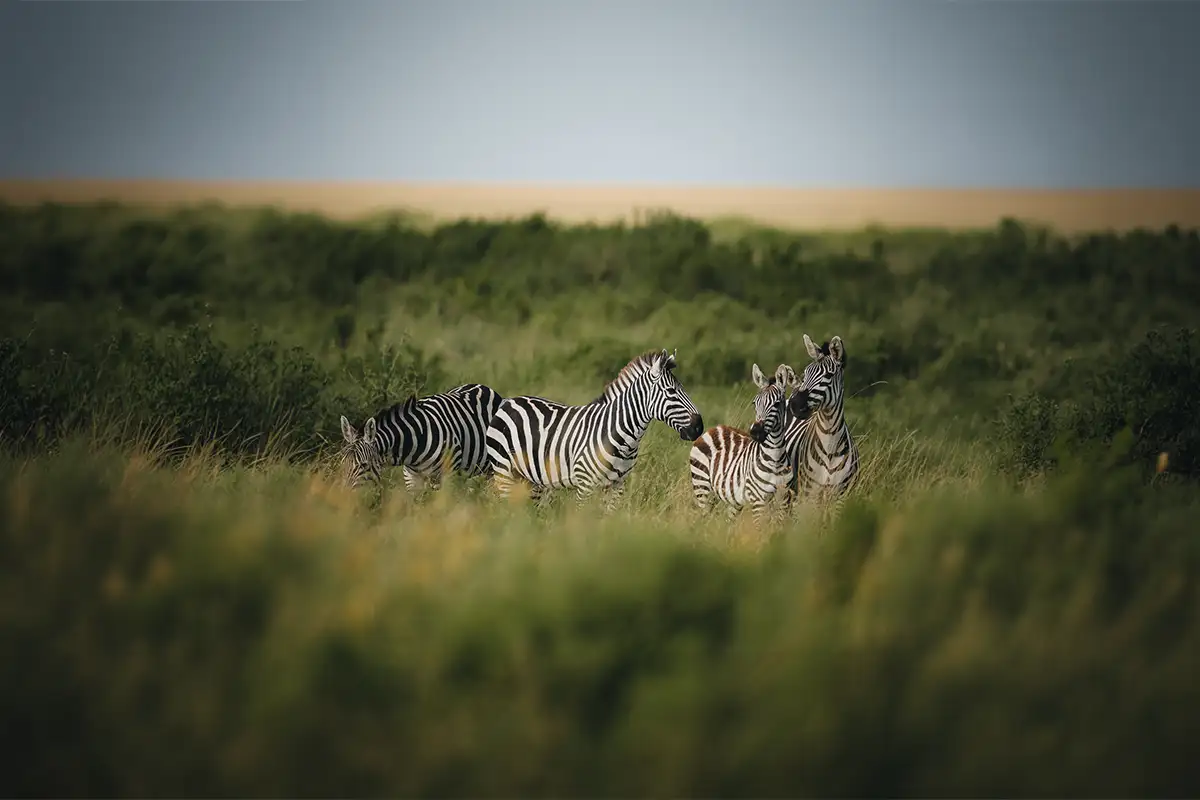
For some guests, this is a moment imagined long before they arrive. Something planned, hoped for and carried quietly in the mind until the morning it might finally happen.
It can be restless, even frustrating. You may wonder whether the herd will move at all, or whether the moment happened somewhere else while you were sitting here.
The herds are close, the river is near, and still nothing can be timed or hurried.
On a game drive, guests are used to movement. There is always another track to follow, another direction to turn, another possibility ahead. During migration season, the stillness can feel just as important. You may sit with the same herd for longer than expected, watching the decision move through it slowly, without any clear beginning or end.
With nothing between you and the morning air, the quiet feels closer. You hear the herd before it moves, the low calls, the shift of hooves, the small sounds that would be easy to miss from farther away.
It changes the pace inside the vehicle. People stop asking what will happen next. They begin to watch more closely instead.
The migration becomes personal at this range. Not because the scene belongs to you, but because you are close enough to feel how uncertain it is. The animals are not performing. The river is not a stage. The moment is simply there, held between movement and hesitation.
When you are in it, the waiting does not feel empty. It feels alive.

A good guide does not rush to explain everything.
Often, it is the quietest moments that tell you the most. A guide who knows the area well will notice when the herd has become unsettled, when the line of movement has changed, or when the animals are holding back for a reason that is not yet obvious to everyone else.
At Nimali Mara, that understanding is built through time in the northern Serengeti, not only through migration season itself. The guides work in this landscape throughout the year, watching how animals move through it in different conditions and reading the smaller changes that shape a day in the northern Serengeti.
For guests, that kind of knowledge changes the experience. It is not only about being taken to where something may happen. It is about beginning to understand what you are looking at while you are there.
The longer you watch, the more the scene begins to make sense.

If the herd moves, the moment has weight because of everything that came before it.
It may begin suddenly, or so slowly that the waiting itself becomes the story before a single animal moves. One animal steps forward, another follows, then the hesitation that held the herd begins to loosen. What happens next belongs to the migration itself, not to any schedule or expectation.
There is power in that movement, but it does not need to be made bigger than it is. By then, you have already felt the tension of the season in the waiting. The crossing, if it comes, is not the whole story. It is the release of something that has been building quietly in front of you.

At Nimali Mara, the Mara River crossings are close enough to shape the day.
The lodge sits among immense boulders, with wide open views across the northern Serengeti. When the herds are nearby, the plains can feel full in every direction, animals moving and gathering as far as the eye can follow.
After hours out on the plains, that setting matters. You return to space, stillness and the feeling that the season is still moving around you.

By the time you return to camp, it is not always the crossing itself that stays with you most clearly.
Sometimes it is the waiting before it. The way the herd held back. The quiet in the vehicle. The sense that everyone was watching the same moment without knowing what it would become.
That is the part of migration that feels most personal. Not the scale of it, or the fact of having seen it, but the feeling of being there while the Serengeti gathered itself around you.
To begin planning your Nimali Mara safari, speak to the Nimali team.


